Q3 2026 Market Reports

Q3 Commercial Real Estate Review: A Stable Carolinas Market
Commercial real estate conditions across the Carolinas remained stable through the third quarter, supported by continued population growth and steady tenant demand across core asset classes. Retail and industrial continue to lead. Retail availability remains low, as construction over the past several years has been modest and concentrated in suburban submarkets, anchored by national big-box and grocery tenants. Industrial leasing momentum remains steady, with demand focused on new, modern product along the interstate corridors and in port-served markets, as the region absorbs recent deliveries and speculative development slows. In the urban cores, multifamily continues to drive new development, and the momentum is building as more people choose urban living.
Population growth remains the driver of all CRE sectors, as the Carolinas continue to rank among the nation’s leaders in in-migration. Housing demand is driving land sales in suburban markets, with employment and retail following close behind. Entitlement challenges continue to slow new single-family housing supply, and higher mortgage rates are constraining demand, thus the housing sector is searching for its equilibrium. Office remains selective, with quality, amenitized and well-located space outperforming older product, and new construction remains limited.
Overall, the market remains stable, but higher long-term rates are the main headwind, weighing on acquisitions, development feasibility and pricing across asset classes. We are hopeful that as energy prices ease, long-term base rates will follow, improving cash flow and project economics. In the meantime, we expect a disciplined but healthy regional market, with new supply following continued population growth. Opportunities are emerging in growing suburbs across the region’s major metros, and renewed activity in urban cores positions the Carolinas for continued growth.
Patrick Chambers, NAI Columbia, Senior Broker, Shareholder
Industrial Report
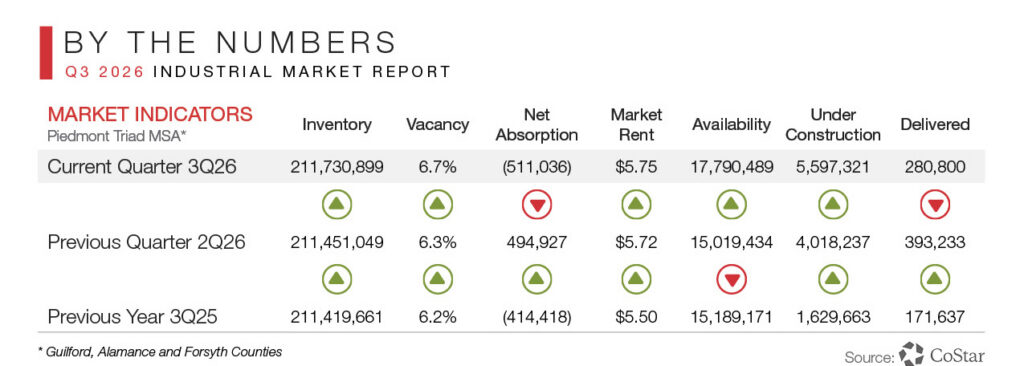
The Triad industrial market took a step back in the third quarter. After nearly 495,000 SF of positive absorption in Q2, the MSA gave back 511,036 SF. That pushed vacancy up 40 basis points to 6.7%, which is 50 basis points higher than a year ago. Availability climbed to 17.8M SF, up 2.8M SF from last quarter, because more space came back to market than was leased. Central Guilford & Airport West drove most of that: absorption there was (386,224) SF and vacancy rose to 7.3%. Forsyth County is trending in a positive direction. It added 215,495 SF for its second straight positive quarter and brought vacancy down to 10.3%.
Rents held up despite a softer quarter. The market average edged up to $5.75/SF, 4.5% above 3Q25, an indication that owners don’t have to compete on quality space. Larger second-generation Class B space is still where the market is weakest.
Developers are still building. New space under construction reached 5.6M SF, up 39% from Q2 and more than triple last year’s 1.6M SF, while deliveries slowed to 280,800 SF. That pipeline reflects confidence in the Carolina Core, where advanced manufacturing is the region’s focus, gaining interest from institutional capital. Finding product to acquire that’s scalable is still hard, because many owners are pricing assets at levels that mostly work for owner-users.
One soft quarter doesn’t necessarily reflect the long-term view, but it does shift some of the leverage toward tenants, who have more options than they did six months ago. Those who understand where the market is heading will find opportunities that won’t be available once the new construction is absorbed. Tammy Dixon, CCIM, SIOR CMB
Retail Market Report
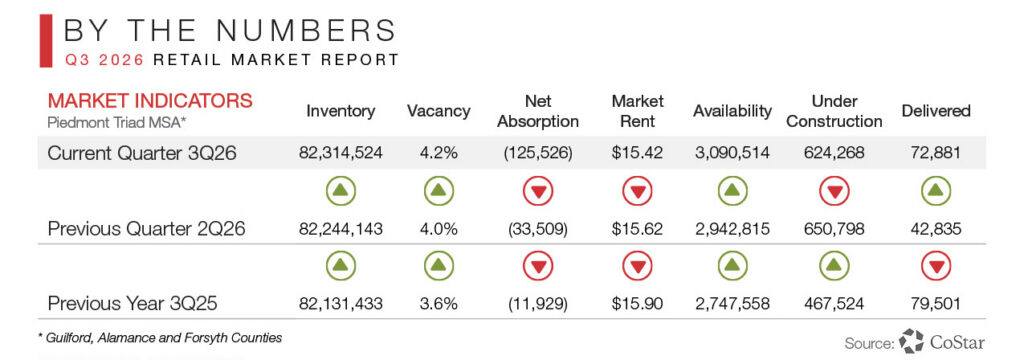
The Piedmont Triad saw demand soften in the third quarter. Net absorption dropped to (125,526) SF from (33,509) SF last quarter, and vacancy moved up to 4.2% compared to 3.6% a year ago. Market rent fell to $15.42, down 1.3% for the quarter and 3.0% for the year. This is likely due to the elevated cost of borrowing, and the Federal Reserve’s rate increase in September, to a range of 3.75% to 4%, adds to that pressure. The local economy is holding up, with unemployment in Guilford, Forsyth and Alamance counties between 3.8% and 4.2% in August, down about half a point from last year.
Smaller tenants are carrying the leasing across the Triad, with food and beverage leading the way along with fitness and medical retail. About 70% of leases were under 3,000 SF. In July, Crunch Fitness leased nearly 29,000 SF at Battleground Plaza in Greensboro. Under construction sits at 624,268 SF, down 4.1% from last quarter but up 33.5% from last year.
There is still demand from institutional investors for grocery anchored shopping centers. In July, InvenTrust Properties purchased the four-building New Garden Crossing in Greensboro for $34 million. Capital is still active, but softer leasing and falling rent point to a cautious fourth quarter. Langston Peoples, Broker
Office Market Report
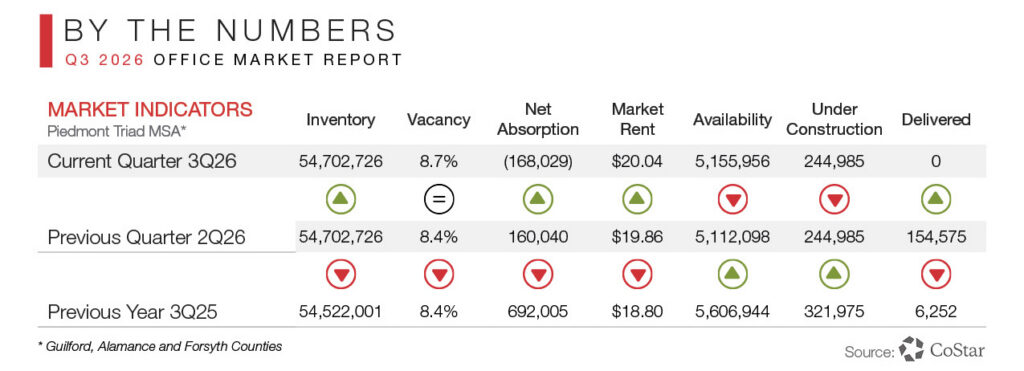
The Piedmont Triad office market currently contains approximately 59.1 million square feet of inventory, with an 8.2% vacancy rate and 5.2 million square feet of available space. Over the past 12 months, the market recorded 87,500 square feet of positive net absorption and 1.4 million square feet of leased space, although net absorption declined 15.9% from the prior period. Market asking rents increased 1.9% to $21.45 per square foot, while average sale prices rose 6.7% to $140 per square foot. Investment activity remains steady, with approximately $271 million in sales volume across 204 transactions and an average market capitalization rate of 10.0%. Meanwhile, office construction has slowed considerably, with 179,000 square feet under construction, down 49.2% from the prior period. Overall, the market shows signs of gradual stabilization, supported by rising rents and sale prices and a smaller development pipeline; however, slowing absorption and substantial available space suggest that tenant demand remains measured. These conditions create opportunities for tenants to negotiate favorable lease terms and for investors to pursue properties with value-add potential, while owners should prioritize competitive pricing, tenant retention, and targeted property improvements. Gerald Stathakis, Broker